
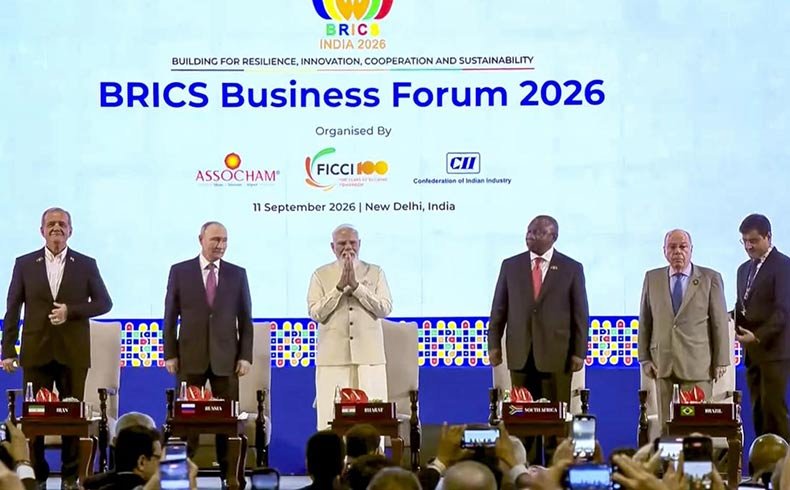
Achievements of India from BRICS. Image Courtesy – The Hindu
Achievements of India is multi-dimensional advantages from its membership in BRICS, spanning geopolitical influence, economic access, development finance, and strategic autonomy.
1. Platform for Global South Leadership & Multi-polarity
- Voice for Developing Nations: BRICS allows India to champion the interests of the Global South, pushing for reforms in global governance bodies such as the United Nations, IMF, and World Bank.
- Counterweight & Strategic Balance: It elevates India into a forum to balance its foreign relations, maintaining strong ties with non-Western powers (like Russia and Brazil), at the same time strengthening strategic partnerships with Western nations (such as the US and EU).
2. Infrastructure Financing via the New Development Bank (NDB)
- Alternative Funding: The NDB provides India with access to substantial development credit for infrastructure, green energy, metro rail systems, and urban development without the political conditions often attached to Western financial institutions.
- Local Currency Financing: The NDB’s push to issue loans in local currencies helps reduce exchange rate vulnerabilities and dependency on the US dollar.
3. Economic and Trade Diversification
- Market Access: BRICS connects India to major emerging markets, facilitating bilateral trade, energy imports (particularly critical oil and gas supplies from Russia and the Middle East), and raw material security.
- Cross-Border Payments & Fintech Sharing: India’s push to digitalize payments (such as UPI integration) finds receptive partners within BRICS to explore alternative local-currency settlement mechanisms and reduce global transaction costs.
4. Direct Engagement with Regional Competitors
- Diplomatic Conduit with China: BRICS provides a permanent, structured multilateral venue for high-level bilateral dialogue with China. This helps manage border friction, bilateral economic imbalances, and regional security concerns outside the spotlight of bilateral disputes.
5. Joint Efforts on Global Security & Technology
- Counter-Terrorism & Cyber Security: This is the most vital issue for the BRICS member states. Through BRICS national security advisors and working groups, India coordinates with member states on intelligence sharing, cyber-threat Peacekeeping and calming, and implementing counter-terrorism measures.
- Supply Chain Resilience & Clean Energy: BRICS initiatives enable collaborative research and policy alignment in renewable energy, healthcare, technology, and supply-chain diversification.

Key Features of BRICS. Image Courtesy – AI Generated
BRICS – The Engine of the Emerging Global South
Originally coined in 2001 by economist Jim O’Neill as “BRIC,” the bloc initially grouped four rapid-growth emerging economies—Brazil, Russia, India, and China—predicting they would collectively dominate the global economy. With the addition of South Africa in 2010, BRICS evolved into a premier formal geopolitical coalition aimed at counterbalancing Western-dominated international structures like the G7, the World Bank, and the International Monetary Fund (IMF).
In recent years, BRICS expanded dramatically. It now encompasses new key regional powers including Egypt, Ethiopia, Iran, the UAE, Saudi Arabia, and Indonesia. Today, BRICS represents roughly 45% of the world’s population, over a third of global GDP (PPP), and nearly half of global crude oil production. Rather than functioning as a military alliance or a single-currency union, BRICS acts as a consultative platform to foster economic integration, trade in local currencies, technological transfer, and reform in global governance.
India’s Key Achievements and Leadership in BRICS
As a founding member, India has historically held a unique position within BRICS: balancing relations between the West and the Global South while resisting attempts to transform the grouping into an explicitly anti-Western front. India has consistently championed a “Humanity-First” agenda, utilizing BRICS as a tool for pragmatic, development-oriented Internationalism.
Some another points that will benefit India in the future –
1. Architectural Anchor of the New Development Bank
One of India’s most substantial contributions was proposing and shaping the New Development Bank (NDB) during the 2012–2014 summits. India insisted on equal voting rights for all founding members—ensuring no single country holds veto power. Indian veteran banker K. V. Kamath served as the NDB’s inaugural president, establishing a multilateral development institution focused on infrastructure and sustainable development across emerging markets without political conditionalities.
Read: India won’t tolerate any haughty step of the USA
2. Institutionalizing Counter-Terrorism Strategies
India successfully shifted the group’s security priorities toward addressing cross-border threats. Under India’s initiative, the bloc adopted the BRICS Counter-Terrorism Strategy and Action Plan. This framework standardizes measures against terrorism financing, radicalization, and the misuse of emerging technologies by extremist networks. During its chairships, India secured explicit condemnations of regional terror attacks in summit declarations.
3. Digital Public Infrastructure & Global FinTech Leadership
India pioneered the export of its Digital Public Infrastructure (DPI)—including UPI, Aadhaar, and open network frameworks—to BRICS nations. By promoting interoperable local-currency payment mechanisms and digital financial inclusion, India enabled BRICS members to lower cross-border transaction fees without relying solely on traditional, cost-heavy Western payment clearing gateways.
4. Championing the Global South and Multilateral Reform
India consistently uses BRICS as a megaphone for developing nations, driving calls for structural reforms in the UN Security Council (UNSC) and global financial institutions. During its fourth chairship, India instituted the BRICS Continuity and Implementation Mechanism to ensure long-term projects retain momentum across rotating chairships.
5. Tactical Bilateral Diplomacy
BRICS has repeatedly served as a crucial diplomatic retreat for India to de-escalate tension during border standoffs or geopolitical friction. High-level meetings on the sidelines of BRICS summits have repeatedly facilitated direct talks between Indian and Chinese leadership, stabilizing bilateral engagement while preserving broader multilateral focus.


