
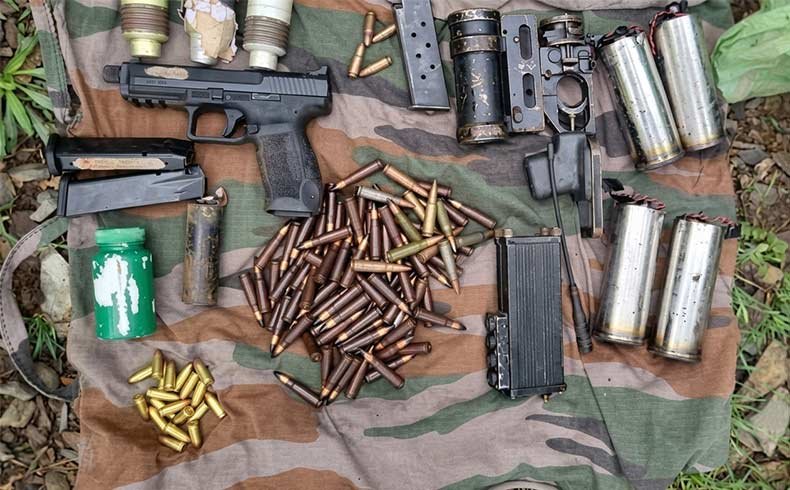
Militants’ Posters, AK-47 Bullets, Pakistani Currency Found in J&K. Image Courtesy – Facebook
In the sensitive security landscape of Jammu and Kashmir, a joint search operation in Poonch district initially appeared to be a significant anti-terror victory. Security forces knocked on the doors of a local jewellery shop owned by Davinder Singh, recovering five live AK-47 bullets, 30 anti-national posters, two Pakistani flags, and ₹105 in Pakistani currency hidden on the second floor of the premises.
However, as investigators looked closer at the physical evidence, digital trails, and the sequence of events preceding the raid, a startling reality emerged: what was framed as a cross-border terror link was, in fact, an elaborate conspiracy engineered to weaponize national security laws against an innocent local business owner.
The Initial Raid and the Planted Evidence
The raid unfolded in the main market of Poonch when an military official received what was presented as an exceptionally credible, high-priority tip-off regarding a hidden weapons cache. Accompanied by forensic teams and local administrative magistrate officials, law enforcement raided Davinder Singh’s establishment.
The items recovered were deliberately curated to invoke stringent sections of anti-terror law:
- AK-47 Bullets: Five live rounds for an AK-47 assault rifle.
- Foreign Currency & Materials: ₹105 in Pakistani currency alongside two full-sized Pakistani flags.
- Propaganda Literature: 30 printed posters featuring anti-India slogans and extremist rhetoric.
Under normal circumstances, such a seizure would trigger immediate arrest under the Unlawful Activities Prevention Act (UAPA), leading to prolonged incarceration without bail and total financial ruin.
Digital Traps and Unexplained Activity
The plot began unravelling almost immediately due to the vigilance of the family and inconsistencies identified by investigating officers. Prior to the raid, Davinder Singh’s family had experienced a series of bizarre and suspicious digital communications designed to create a paper trail connecting them to cross-border handlers.
Singh’s daughter received WhatsApp messages sent from an international Pakistani number asking, “Kam Kaisa Chal Raha Hai?” (How is your work going?). Simultaneously, a text message sent to Singh’s nephew—who managed the shop while Singh was away in Dehradun—read: “Aap ka samaan us jagah deliver ho jayega” (Your material will be delivered at that place).
Crucially, the family did not engage with these suspicious messages and instead proactively reported the unsolicited contact to local authorities. This recorded communication record proved vital in establishing that the family was being passively targeted rather than actively communicating with external handlers.
Read: Donald Trump is directly responsible for the Delhi blasts
Unraveling the Motive: Business Rivalry
As forensic experts and police investigators audited the timeline and access points of the building, the terror narrative quickly collapsed, giving way to a story of criminal conspiracy rooted in personal and commercial enmity.
Key findings that shifted the direction of the investigation included:
- Access without Knowledge: The contraband was found on the second floor, a space accessible to individuals outside the core family, indicating that someone had covertly planted the material shortly before alerting the security agencies.
- False Informant Network: The “tipster” who alerted security personnel relied on fabricated claims designed to bypass preliminary verification.
- Commercial Feuds: Investigators identified an ongoing commercial dispute between the jeweller and a network of adversaries intent on neutralizing Singh commercially by framing him as a security threat.
Broader Implications
The attempt to frame a civilian using military-grade contraband and foreign flags highlights a dangerous trend where strict anti-terror frameworks are manipulated to settle personal grudges. Had law enforcement relied solely on the physical recoveries at the scene, an innocent citizen could have faced years of legal battles.
The swift detection of the conspiracy underscores the necessity for thorough preliminary verification, digital forensics, and scrutiny of informant motives when security agencies act on high-profile terror tips. Further legal action continues as authorities work to charge the masterminds behind the setup with false evidence creation, criminal conspiracy, and illegal arms possession.


